Farm tips #7

Hi! Today’s farm tip will discuss dogs. If a dog pulls when on the leash, most people think that a harness would be a better thing to use when walking your dog. However this is not the case, you should not use a harness for your untrained dog. Once they are trained to walk nicely a harness can be ok.

A dog’s chest is much stronger than their neck. So if you have a dog that pulls and you harness them, you are allowing them to use their chest to pull against you. Thus, instead of correcting the pulling, you have only made it worse.

Also, there are front clip harnesses which are called no-pull that are harmful to your dogs body because they prohibit the shoulders from moving properly. These should not be used.

If someone tells you to buy a choke collar, do not listen to them. A dog that seriously pulls will not stop pulling just because something is choking them. If you have a dog like this, you will kill them. The choke collar gets smaller under the force of the pulling and eventually if the dog doesn’t stop pulling, it will collapse their esophagus.

People also try to use a shock collar which does not train a dog. It forces them to do what you want instead of having them walk nicely because they want to.

A prong collar may be ok to use, but it still doesn’t train the dog it just prevents them from pulling. And on a serious puller it will hurt their neck.

The best way to walk a dog is with a normal collar, 6ft leash, and lots of training using positive reinforcement (treats, a toy, a scratch, whatever your dog enjoys). Once you go through with training, you can skip the treats and have a dog that doesn’t pull. It will feel rewarding if you put the time in instead of trying to force them to obey with a shock collar or anything like that. If you are struggling, try using a gentle leader and train them with that.

  • choke collar-NEVER use
  • prong collar- use with caution if absolutely necessary
  • harness-NEVER use
  • shock collar-NEVER EVER USE, doesn’t really train a dog
  • Gentle leader-use with training if you need it or want it, or train with a regular collar

Thanks for reading!
Farm tip #6

Welcome back! Allow me to share a fun fact about sheep with you.

Did you know that sheep are immune to snake bites? If you don’t believe me read the attached excerpt below.

“It is a biological product that typically consists of venom neutralizing antibodies derived from a host animal, such as a horse or sheep. The host animal is hyperimmunized to one or more snake venoms, a process which creates an immunological response that produces large numbers of neutralizing antibodies against various components (toxins) of the venom.[2] The antibodies are then collected from the host animal, and further processed into snake antivenom for the treatment of envenomation.”

To learn more about this amazing fact go to: https://en.wikipedia.org/wiki/Snake_antivenom. This is where the above quote came from.

Thanks for reading! If you have a farm tip suggestion, comment below.

Farm tips #5

Hi, I know its been a while but today I will share another farm tip with you. A little advice on what each type of animal needs in regards to vet care. Allow me to address one very important point. Do you have a reliable vet that you can count on to help give medical attention to your sick animals? If you don’t, find one ASAP.

Horses need frequent visits from a farrier (about every 6-8 weeks), if they don’t wear shoes they still need their hooves trimmed. They need annual vet checks, which should include: teeth checks, vaccinations (ask your vet what shots are needed for your area), and a coggins test. Some common vaccines for horses are: West Nile, Rabies, Tetanus, Strangles*, EHV* (equine herpes virus), influenza*, and there are others. Horses also need worming. Talk to your vet to set up a worming plan that’s right for your horse(s).

Goats and sheep need pretty much the same care as horses with a few exceptions: no teeth care and different vaccines. There are a couple different vaccines for goats, on our farm we do one, the CDT, but talk to your vet to see if more are needed for your herd. Sheep need a CDT annually too. Be sure to check their goat and sheep hooves and clip them if necessary. Check the FAMACHA score regularly and keep worms under control. Talk to your vet about worming plans.

Donkeys need the same type of annual care as horses. One note, not every farrier is willing to trim donkeys hooves so be sure yours is willing to do donkeys.

Cows need a CDT just like sheep and goats. The only challenge is dealing with their size. You can use oral worming methods but because they weigh so much they would require a lot of it and it isn’t that easy to get a drencher in their mouth. For convenience, you can buy pour on wormer. It takes less time to pour it on than to figure out how to shove a syringe in a cows mouth.

* – If you don’t trailer your horses anywhere and they are not exposed to other horses that travel, your horse(s) may not need these vaccines. Ask your vet what vaccines are needed for your area and purpose

Thanks for reading!

Farm tips #4

Have you ever wondered, “should I dehorn my goat or not?”. Well the answer to that question is completely up to you.

The pros and cons of dehorning a goat:

Pros:

  1. You don’t have to worry about getting hurt, and the goats won’t hurt each other. Getting hurt is not necessarily going to happen, unless you have goats that are mean or are super greedy for food.
  2. Horns get caught in the fence. There is a solution to this, get a fence that goats can’t get their heads through. Even without horns, if a goat sticks it’s head through the fence and gets butted by another goat they can get hurt.

Cons:

  1. Goats horns can actually help cool them down. The blood circulates inside cooling them down.
  2. If you hold the disbudding tool on the goats head too long, it can cause brain damage. But, not holding it on long enough can cause the horns to only be partially burnt so they still grow.
  3. If you already have horned goats then you can’t have a goat without horns because the horned goats will bully the one without horns.
  4. It gives you something to grab when you’re trying to catch them. Even if they’re friendly, they will still try to get away when they need to be caught.

Personally, I like horns because they look cool, and it’s easier to catch them with horns. Some goats are naturally polled so if you want a goat without horns consider finding a naturally polled goat. I hope this helps you understand the pros and cons of disbudding a goat.

Farm tip #3

Here is an idea of where to start for a multi-animal first aid kit. There are a lot more possibilities of items to add, so ask your vet or a friend who owns animals what items you might need. Just remember, you don’t have to go overboard, but always have the most important items to use in case of emergency.

  • Livestock thermometer
  • Gauze
  • Adhesive bandages (Vetwrap)
  • bandage scissors
  • Syringes
  • Needles
  • Bloat remedy solution
  • Activated charcoal
  • wound spray
  • Disinfectant
  • Rags
  • Vitamin B1
  • Paper towels

Here are some things that are more for horses.

  • Phenylbutazone
  • Banamine

Farm tips #2

Hi, my second tip is about eggs. First, if you collect eggs from the coop and don’t wash them, then they stay good for a few months on the counter. If you wash them then you have to put them in the fridge and they only last a week.

One more useful thing to know is that if you put an egg in a cup of water, and it floats, it is rotten. If it stands on one end, use it ASAP. If it sits on the bottom of the cup it is fresh.

Farm tips #1

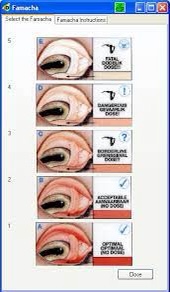
Hi, this farm tip is about checking the FAMACHA score on a goat or sheep. If you gently pull down the bottom eyelid and then gently pull the top one up, the color on the underside of the eyelid will give you an idea of whether or not the animal needs worming. A healthy goat or sheep should have a very pink eyelid. If it is very pale, give a dose of wormer. Below is a famacha card. Thanks to google.

For sheep, you can use Cydectin sheep drench. For goats, you can use Albendazol. If you need to do a monthly plan, use them interchangeably. For instance, use cydectin then the next month use Albendazol.